How are refractive surgery outcomes studied?
“99 % of patients satisfied” and “10/10 vision without glasses” are the kinds of figures you often see in refractive surgery. They can be accurate and still measure different things. Clinical studies measure outcomes using precise, standardised criteria. Knowing these helps you read a brochure, website or article critically and ask the right questions at your consultation.

Four types of clinical outcome
Specialist refractive surgery journals ask authors to report their results in a common format. It addresses four questions.
| Measure | Question | How it is measured |
|---|---|---|
| Efficacy | How well can you see without correction? | Percentage of eyes reaching a given visual acuity without glasses, often 10/10 |
| Predictability | Was the target correction achieved? | Percentage of eyes within less than 0.50 dioptres of the target, and then within less than 1 dioptre |
| Safety | Did surgery reduce the best vision the eye can achieve? | Percentage of eyes losing two or more lines of acuity with the best correction |
| Stability | Does the result last? | Changes in refraction between successive follow-up visits |
Studies increasingly record patient-reported outcomes alongside these clinical measures. Validated questionnaires assess visual symptoms, dry eye, satisfaction and quality of life.

Why safety is the most important measure
Efficacy tells you whether you will see well without glasses. Safety tells you whether you will see less well than before with glasses, meaning that the eye has lost some of its potential. A loss of two lines or more is rare in modern studies, but it still occurs. A study is incomplete if it does not report it.
What large studies show
Satisfaction. A literature review published in Ophthalmology in 2009 pooled studies of satisfaction after LASIK. Of 2 198 patients, 95.4 % said they were satisfied. This is a robust finding, but it covers published studies, often run at university centres and using some older techniques.
Reported symptoms. The FDA’s PROWL studies, published in 2017, surveyed 262 and then 312 patients before and after LASIK. They give a more detailed picture.
- The overall prevalence of visual and dry eye symptoms fell after surgery.
- However, 43 to 46 % reported at least one new visual symptom at three months, most often halos, glare or starbursts around lights, usually causing little bother.
- Around 28 % of patients without dry eye before surgery reported it at three months.
- Conversely, 65 % of those who had dry eye before surgery had normal scores at three months.
- Less than 1 % reported major difficulties in their usual activities due to these symptoms.
The two findings are compatible. The vast majority of patients are satisfied, and a sizeable minority notice visual changes, usually moderate and temporary.
Questions to ask about a figure
- How many patients or eyes? A percentage based on 40 eyes is less precise than one based on 4 000.
- Which patients? Results for mild myopia do not apply to high myopia or presbyopia.
- When? At one month, vision can still change. Results at one year or later tell you more.
- How many patients were lost to follow-up? People who miss follow-up visits may still be having problems.
- Which technique and which device? Older studies do not always reflect today’s lasers.
- Who funded the study? Industry funding does not invalidate a study, but it must be disclosed.

What this means for you
An average cannot predict your individual outcome. Your assessment shows what matters for your eyes: your prescription, corneal shape, tears and pupil. Ask your surgeon what results to expect in your situation, which side effects are most likely for you and what can be done if they occur. Risks and symptoms to report
The doctors at Annecy Ophtalmo publish regularly in scientific journals. The team’s publications, on annecy-ophtalmo.fr
In summary. A well-conducted study reports efficacy, predictability, safety and stability, along with patient-reported symptoms. Satisfaction is high in large studies, but a minority notice halos or dry eye, often temporarily. When you see a figure, ask how many people it covers, who they were and when the outcome was measured.
Frequently asked questions
Why do centres report different rates?
They measure different things in different patients and at different times. To compare rates, you need to know what each one measures and how many people or eyes it covers.
What is a further correction, and is it counted in the results?
It is a second treatment to correct a remaining vision problem. A well-conducted study specifies whether the results presented include or exclude the effects of further correction.
How do I read a satisfaction survey published by a centre?
Ask the same questions about the number of responses, timing and wording of the questions. How to read patient satisfaction survey results
Check your eligibility to discuss the options with a surgeon.
Sources
Related reading
All news
News
When your myopia prescription changes
Before refractive surgery, the first question is whether your myopia is stable. A laser corrects the myopia measured on the day of…
22 April 2026
News
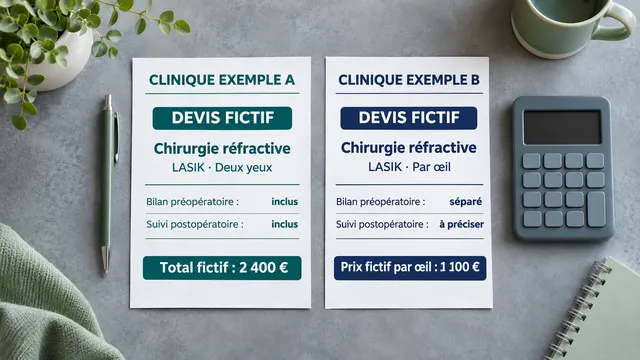
How to compare two quotes for refractive surgery
Refractive surgery is a significant expense and the French statutory health insurance scheme (Assurance maladie) rarely reimburses it. It makes sense to…
26 October 2026

News
Why the eye surface matters before laser surgery
Tears rarely come to mind when preparing for refractive surgery, yet they play two important roles. The tear film is the eye's…
27 February 2026
Have a question about your situation?
An assessment tells you what is and isn’t possible and allows you to get a quote.