PRK (PKR)
PRK (PKR), or photorefractive keratectomy, corrects short-sightedness (myopia), long-sightedness (hyperopia) and astigmatism by treating the corneal surface without creating a flap. It is the oldest laser technique and remains a suitable choice in specific situations, such as a slightly thin cornea or activities where you may be hit in the face. Recovery is slower than with LASIK, which is worth knowing before you choose.
Book an appointment online
Doctolib · Refractive surgery, first consultation
Online booking is in French. Reception answers the phone.
What happens during the procedure
The procedure takes a few minutes per eye and uses anaesthetic eye drops.
- The epithelium is removed. This is the outer layer of the cornea, about 50 microns thick. It can be removed with a brush, with diluted alcohol or directly with the laser in transepithelial PRK (PKR).
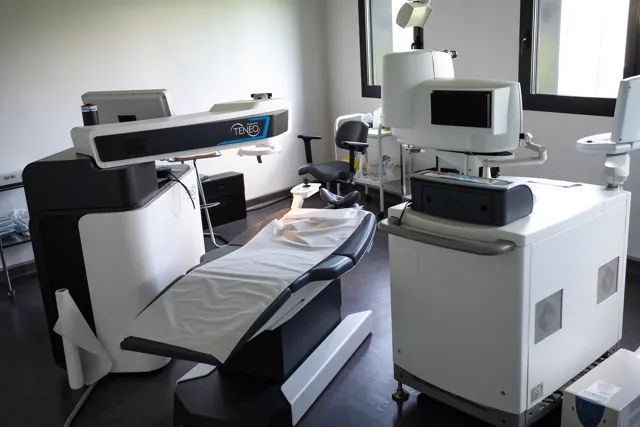
- The excimer laser reshapes the stroma, the tissue that gives the cornea its shape. The centre uses the TENEO 2. Treatment generally takes less than a minute.
- A bandage contact lens is fitted to protect the surface while the epithelium grows back.
What to expect in the first few days
This is where PRK (PKR) differs. Until the epithelium covers the cornea again, your eye is sensitive. It can sting, water or feel sensitive to light, and there may be noticeable pain for the first two or three days. The prescribed eye drops and rest help ease the pain. Your surgeon removes the contact lens once the surface has healed over. Your vision then improves gradually over several weeks.
| Activity | General guidance |
|---|---|
| Returning to work | 3 to 5 days on average at the centre. As this is elective surgery, no sick leave is prescribed. Plan the procedure during your time off |
| Driving | Once your vision is stable and comfortable and your surgeon agrees |
| Sport | Depending on your symptoms, resume when your eye feels comfortable. More demanding activities should wait until later, with your surgeon’s approval |
| Sun protection | Essential for several months, as UV exposure increases the risk of haze (healing opacity) |
These timings are a guide, not a guarantee, and vary from person to person. Returning to sport after surgery
Why choose PRK (PKR) over LASIK?
- A slightly thin cornea. Without a flap, more corneal thickness is preserved beneath the treatment area.
- A sport or job with frequent blows to the face, such as boxing, MMA or certain physically demanding jobs. A LASIK flap never becomes as strong as an intact cornea. Much depends on how often you are hit. Describe exactly what your activity involves at your assessment.
- A corneal surface that makes it appropriate, for example with superficial irregularity, based on the corneal topography.
If you need to get back to an activity quickly, LASIK will often be more comfortable. Comparing the three types of corneal surgery
Risks and limitations
- Haze (healing opacity) is a superficial clouding, particularly with stronger corrections and after sun exposure. Sun protection helps prevent it. Eye drops are the usual treatment.
- A residual prescription may require further treatment if the cornea is thick enough.
- Dry eye, halos at night and glare can occur. They are generally less pronounced than after surgery with a flap and ease over time.
- Infection is rare but serious. Call the centre the same day if your pain increases or your vision gets worse.
Alternatives
Glasses and contact lenses remain valid options. Depending on your cornea and prescription, your surgeon may also suggest LASIK, SILK lenticule extraction for myopia, or a phakic implant for very high myopia.
At the centre in Argonay
Dr Florian Baudin, Dr Florian Chaise and Dr Aurélia Gave perform PRK (PKR). Before any laser treatment, we measure the shape (topography) and thickness of the cornea, check the surface of your eye, and measure your prescription with drops that temporarily relax focusing (cycloplegia). Prepare for your assessment · Care pathway and follow-up · Book an appointment
General information. An assessment is the only way to determine whether surgery is suitable and provide you with a quote (devis).
References
- Société française d'ophtalmologie, fiche 09A, chirurgie réfractive cornéenne au laser
- American Academy of Ophthalmology, PRK
- Annecy Ophtalmo, refractive surgery procedures
Book an appointment online
Doctolib · Refractive surgery, first consultation
Online booking is in French. Reception answers the phone.