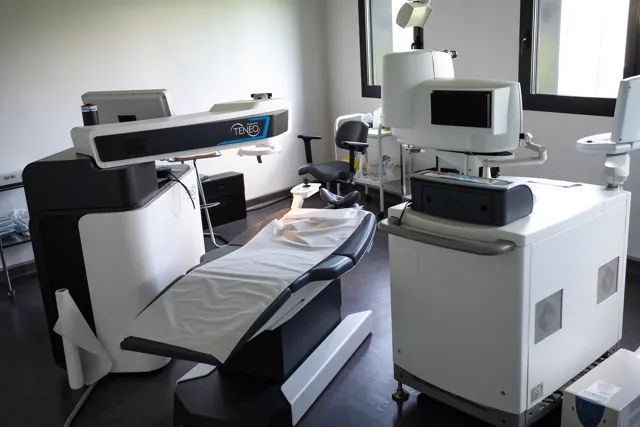
PresbyLASIK
Around the age of 45, the natural lens loses flexibility and focusing up close becomes difficult. This is called presbyopia. PresbyLASIK uses a laser to reshape the cornea so the eye can see well enough to carry out tasks both far away and up close. There are trade-offs, and the procedure cannot restore the vision you had when you were younger. It is worth understanding these trade-offs before deciding. At the centre, the procedure is performed by Dr Florian Baudin and Dr Aurélia Gave.

Book an appointment online
Doctolib · Refractive surgery, first consultation
Call the officeOnline booking is in French. Reception answers the phone.
How laser treatment addresses presbyopia
There are two approaches.
- Monovision (or mini-monovision). One eye is corrected for distance vision. The other is left slightly short-sighted for near vision. The brain learns to use each eye according to the distance.
- Multifocal corneal reshaping. The laser shapes the cornea into zones with different focusing powers, allowing the eye to see clearly at several distances.
In both cases, you trade some visual quality for less reliance on glasses.
Benefits and trade-offs
| Benefits | Possible trade-offs | |
|---|---|---|
| Monovision | Reading and screen use without glasses in most cases | Slightly less sharp distance vision with one eye, and less precise depth perception |
| Multifocal corneal reshaping | Clear vision at multiple distances with both eyes | Reduced contrast, halos at night |
Night driving, precision work such as sewing, jewellery making or surgery, and shooting or high-speed sports are all examples of activities to mention at your assessment. Near vision after 45
Presbyopia continues to change
Treatment corrects presbyopia as it is at the time of surgery. As the natural lens continues to age, you may still need a reading prescription years later, especially in low light. After the age of 55 to 60, or if an early cataract develops, lens surgery to correct your vision may be more suitable than treating the cornea. Cataracts and premium implants
Who may or may not be suitable
The assessment is the same as for any laser treatment. It checks the thickness and shape of the cornea, your tears and your prescription with drops that temporarily relax focusing (cycloplegia). Significant dry eye, an irregular cornea or an early cataract point towards another option. Varifocal glasses and multifocal contact lenses remain alternatives in their own right.
Risks
The risks are similar to those of LASIK: dry eye, halos, residual prescription and possibly needing further treatment. An additional risk is finding that you cannot adapt to the trade-off you have chosen.
Prepare for your assessment · Care pathway and follow-up · Appointments
From about 55 to 60 and beyond, replacing the lens with an implant (PRELEX) takes over from laser treatment.
General information. An assessment is the only way to determine whether surgery is suitable and provide you with a quote (devis).
References
- American Academy of Ophthalmology, presbyopia
- Société française d'ophtalmologie, patient information leaflets
Book an appointment online
Doctolib · Refractive surgery, first consultation
Call the officeOnline booking is in French. Reception answers the phone.