Near vision after 45: what questions should you ask?
Holding the menu further away, stretching out your arm to see your phone or needing bright light to read a medicine leaflet are familiar signs. Around 40 to 45, everyone's near vision changes. This is presbyopia, a normal part of ageing with many correction options. Which one suits you depends more on your existing vision, your working distances and the trade-offs you are comfortable with than on your age.

What happens inside the eye?
To focus up close, the natural lens behind the iris becomes more rounded. This is called accommodation. Over time, the lens stiffens and loses this ability. Presbyopia progresses until about the age of 60 and then stabilises. On your prescription, it appears as an addition, extra focusing power for near vision that increases in steps.
| Approximate age | Typical addition | What you might notice |
|---|---|---|
| 45 | +0.75 to +1.00 | Reading is tiring in the evening and small print is hard to see in dim light |
| 50 | +1.50 | Reading glasses are needed for most reading |
| 55 | +2.00 | A computer screen can look blurred without correction for intermediate distances |
| 60 and over | +2.50 | Presbyopia barely progresses further |
These figures are a guide. Presbyopia progresses at different rates. How to read your glasses prescription

How your existing prescription affects presbyopia
- If you have never needed glasses, presbyopia is when you first start wearing them.
- If you are short-sighted, you can often read by taking your glasses off, because a short-sighted eye naturally sees clearly up close. This is why some patients who have had myopia surgery are surprised to lose the ability to read without glasses at around 45.
- If you are long-sighted, you notice presbyopia earlier and more strongly, because your eyes were already relying on accommodation to see clearly. Long-sightedness and close work
Options from the simplest to those requiring more commitment
| Option | How it works | What to know |
|---|---|---|
| Reading glasses | Simple lenses for close work | Low cost, but distance vision is blurred, so you take them off and put them back on |
| Varifocals | One pair of glasses for all distances | A few days to adjust, with a narrower field of vision at intermediate distances |
| Office lenses (degressive) | Designed for viewing screens and printed pages | Very comfortable at work, unsuitable for driving |
| Multifocal contact lenses | Several areas with different powers on each lens | Try them to see if you adapt. They can slightly reduce contrast |
| Monovision | One eye corrected for distance and the other for near vision | The brain often adapts. Try this first with contact lenses |
| PresbyLASIK | A laser reshapes the cornea to increase depth of focus | For suitable eyes and corneas without significant cataract |
| Refractive lens exchange (PRELEX) | The natural lens is replaced with a multifocal or extended depth of focus implant | Usually considered after 55 to 60. It is the same operation as cataract surgery and removes the need for cataract surgery later |
PresbyLASIK at the centre
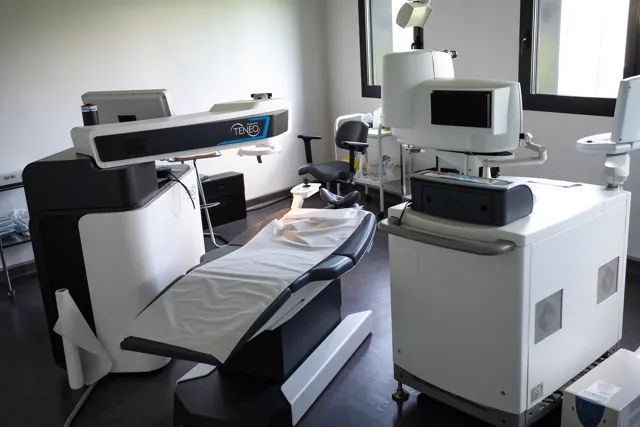
Annecy Laser Vision performs PresbyLASIK using the SUPRACOR profile on the TENEO 2 excimer laser. It reshapes the cornea to make reading easier while preserving distance vision. It is an option for people with presbyopia whose eyes and corneas are found suitable at a full assessment. Like any correction for presbyopia, it can involve trade-offs. Some patients have slightly reduced contrast or less sharp night vision. A further correction may be needed, and glasses can still help with prolonged reading in dim light. As presbyopia continues to progress, the improvement in near vision may diminish over the years. PresbyLASIK · Presbyopia and SUPRACOR, on annecy-ophtalmo.fr
What about eye drops?
Eye drops that reduce pupil size produce a pinhole effect, increasing depth of focus. They have been developed to improve near vision temporarily. A separate article covers their availability in France, how long they work and possible side effects. Presbyopia: can eye drops replace reading glasses?
Questions to consider before your consultation
- At what distances do you work? For example, a screen at about 60 cm, reading at 35 to 40 cm, or a workbench or dashboard.
- How much do you read each day, and in what light?
- Do you often drive at night?
- Would you be comfortable using glasses for specific tasks?
- Have you tried monovision with contact lenses?
An initial examination is also a chance to check for other conditions that appear at this age, such as glaucoma, which often causes no symptoms. A sudden drop in vision requires prompt assessment as presbyopia does not develop suddenly.
In summary. Presbyopia affects everyone and progresses until about 60. Glasses, contact lenses, PresbyLASIK and lens replacement suit different situations. Bring details of your working distances and what you hope to achieve, as these guide the choice.
Frequently asked questions
Does wearing reading glasses make presbyopia worse?
Presbyopia progresses with age whether or not you wear glasses. Reading glasses make reading more comfortable.
I had myopia surgery 15 years ago and can no longer see up close. Has the laser effect worn off?
This is presbyopia, which also affects eyes that have had surgery. The same correction options are available as for other people.
At what age can you consider lens replacement?
There is no fixed age, but it is more often considered after 55 to 60, especially in people with long-sightedness or early cataract. Implants and lens surgery, on annecy-ophtalmo.fr
Book an appointment or check your eligibility to review your near vision.
Sources
Related reading
All news
News
How to read patient satisfaction survey results
In October 2025, 188 people who had surgery at Annecy Laser Vision answered our satisfaction survey, and 94.3 % said they were…
19 November 2025
News
Why the eye surface matters before laser surgery
Tears rarely come to mind when preparing for refractive surgery, yet they play two important roles. The tear film is the eye's…
27 February 2026

News
What to bring to your assessment
The refractive surgery assessment answers a specific question: can your eyes be corrected surgically, and if so, how? The measurements are taken…
5 January 2026
Have a question about your situation?
An assessment tells you what is and isn’t possible and allows you to get a quote.