How to read your glasses prescription
A glasses prescription may be just two rows of numbers, but it tells you the type and degree of your vision problem, whether you have astigmatism and, from about age 40, whether you need help seeing up close. Reading it helps you track changes from year to year and prepare for a refractive surgery assessment.
A worked example
Here is a fictitious prescription in a common format.
| Sphere | Cylinder | Axis | Addition | |
|---|---|---|---|---|
| OD (right eye) | −3.25 | −1.00 | 170° | +1.50 |
| OG (left eye) | −2.75 | −0.50 | 10° | +1.50 |
Sphere corrects short-sightedness (myopia) or long-sightedness (hyperopia). A negative number indicates myopia (the image forms in front of the retina, so distant objects look blurred). A positive number indicates hyperopia. Here the right eye has 3.25 dioptres of myopia. A dioptre is a unit of lens power. Prescriptions go up in steps of 0.25.
Cylinder corrects astigmatism, which occurs when the cornea or natural lens curves differently in different directions. If there is no cylinder value, there is no astigmatism to correct. Here the right eye has 1 dioptre of astigmatism.
Axis gives the orientation of the cylinder, from 0 to 180°. It is only meaningful when there is a cylinder value. The 170° and 10° axes are both close to horizontal. What the axis means on a prescription
Addition is the extra power needed for near vision, from about 40 to 45 years of age, as the natural lens becomes less flexible. This is called presbyopia. The addition is always positive and is usually the same in both eyes.
Why two prescriptions can describe the same correction
Prescriptions can use either of two conventions. French ophthalmologists most often use a negative cylinder. Some instruments and opticians use a positive cylinder. To convert from one to the other, transpose the prescription.
- add the sphere and cylinder to get the new sphere
- reverse the sign of the cylinder
- add or subtract 90° from the axis.
So −3.25 (−1.00) 170° can also be written as −4.25 (+1.00) 80°. The lens is the same. If two prescriptions look very different, check the sign of the cylinder first.
Tracking changes with the spherical equivalent
To compare two prescriptions quickly, calculate the spherical equivalent by adding half the cylinder to the sphere. In the example, the right eye is −3.25 + (−0.50) = −3.75. If last year’s prescription gave −3.50, the myopia has changed by 0.25 dioptres, which is within the margin of measurement. A repeated change of 0.50 dioptres or more a year indicates that the myopia has yet to stabilise. This is one of the first things checked before refractive surgery. When your myopia prescription changes
What may be missing from your prescription
- Pupillary distance is measured by the optician when fitting the lenses.
- Prism is included only for certain eye alignment problems.
- Lens type (single vision, progressive or intermediate-distance) is sometimes specified.
- Contact lenses need a separate prescription with the curvature radius and lens diameter. The power can differ from your glasses prescription, especially above 4 dioptres, because a contact lens sits on the eye while a glasses lens sits about a dozen millimetres in front of it.
How long is a prescription valid?
In France, an optician can supply or adapt glasses from a prescription for 5 years between the ages of 16 and 42 and 3 years from age 43. It is valid for one year before age 16. For contact lenses, it is valid for 3 years from age 16. The French statutory health insurance scheme (Assurance maladie) generally reimburses one pair every two years for adults, or sooner if your vision has changed. Since 2023, an orthoptist can also prescribe glasses in some circumstances for people aged 16 to 42. Renewing glasses through an orthoptist, on annecy-ophtalmo.fr
A valid prescription measures your correction. You still need an eye examination to check the health of your cornea, natural lens and retina.
Why bring your previous prescriptions to the assessment?
For a refractive surgery assessment, your prescription history matters as much as today’s measurement. Prescriptions spanning three to five years can show whether your correction is stable, whether the astigmatism axis is changing (which may suggest an irregular cornea) or whether long-sightedness is becoming apparent with age. Photograph the prescriptions and put them in date order. What to bring to the assessment
In summary. A negative sphere means myopia and a positive one means hyperopia. The cylinder and axis describe astigmatism. The addition is for near vision. To compare prescriptions, check which cylinder convention is used and calculate the spherical equivalent.
Frequently asked questions
What does « plan » or « 0 » mean on my prescription?
That eye does not need spherical correction. There may still be a cylinder or an addition.
My glasses and contact lenses have different powers. Is that a mistake?
The distance from the lens to the eye affects the power you need. For myopia of −6, a contact lens is generally a little weaker than the glasses lens.
How strong does my prescription have to be for refractive surgery?
There is no fixed minimum. What matters is how much your vision bothers you, whether your prescription is stable and what the corneal examination shows. Strong prescriptions can sometimes be better suited to an implant than to laser treatment. Am I eligible?
Book an appointment to check whether your current correction still suits your vision.
Sources
Related reading
All news
News
Near vision after 45: what questions should you ask?
Holding the menu further away, stretching out your arm to see your phone or needing bright light to read a medicine leaflet…
3 April 2026
News
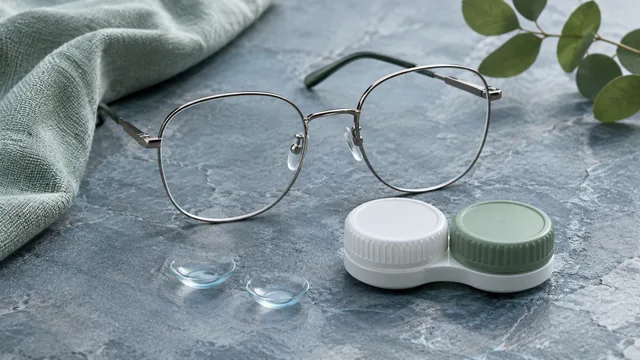
Soft contact lenses, rigid contact lenses and glasses
Glasses or contact lenses? The answer depends on your prescription, your activities and what your eyes can tolerate. Knowing the advantages and…
11 May 2026

News
Why the eye surface matters before laser surgery
Tears rarely come to mind when preparing for refractive surgery, yet they play two important roles. The tear film is the eye's…
27 February 2026
Have a question about your situation?
An assessment tells you what is and isn’t possible and allows you to get a quote.