What the axis means on your glasses prescription
On a glasses prescription, the axis can be the most puzzling number: 5°, 90°, 175° and so on. It gives the direction of the correction. The cylinder gives its strength. An axis is only used if you have astigmatism. Knowing what it means helps you read your prescriptions and spot something ophthalmologists watch closely: an axis that shifts over the years.
Astigmatism in a picture
A cornea without astigmatism curves evenly, like a football. A cornea with astigmatism is more like a rugby ball or the back of a spoon. It curves more in one direction than in the direction at right angles to it. Light then focuses along two lines instead of at one point, and vision is blurred or distorted at all distances. Mild astigmatism is very common and often causes no discomfort. Above about 0.75 to 1 dioptre, it often causes eye strain, headaches and halos at night.

Why the axis runs from 0 to 180°
The axis gives the direction of the cylinder, the correction for astigmatism, on a semicircle marked in degrees. Under the international TABO convention, 0° and 180° are horizontal and 90° is vertical, looking at the patient face-on. No axis exceeds 180° because a line at 200° is the same as a line at 20°.
In practice, a 5° axis is very close to a 175° axis. Both are 5° from horizontal. Do not worry if your prescription changes from 178° to 2°. The orientation has hardly changed.
With-the-rule, against-the-rule and oblique astigmatism
Most French ophthalmologists write prescriptions using the negative cylinder convention.
| Cylinder axis | Type | What it means |
|---|---|---|
| Around 180° (from 150 to 30° across the horizontal) | With-the-rule astigmatism | The cornea is more curved vertically. This is the most common type in children and young adults |
| Around 90° (from 60 to 120°) | Against-the-rule astigmatism | The cornea is more curved horizontally. This becomes more common with age |
| In between (around 45° or 135°) | Oblique astigmatism | Often more bothersome at the same strength because the brain adapts to it less easily |
Over time, astigmatism tends to shift gradually from with-the-rule to against-the-rule. This is a slow, natural change.
When a shift in the axis matters
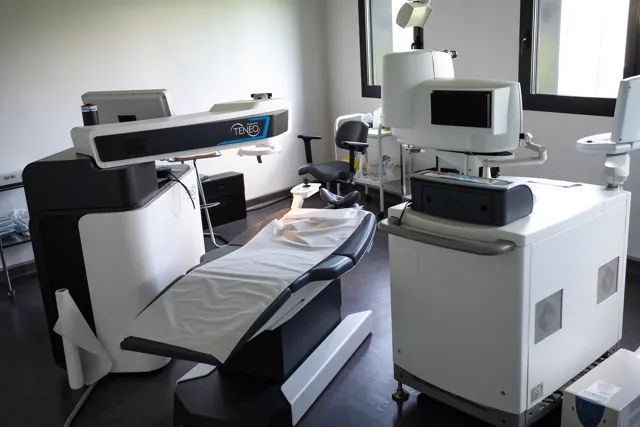
Increasing astigmatism with a marked shift in the axis between prescriptions over a few years is worth checking, especially in a teenager or young adult. It can be a sign of keratoconus, a condition in which the cornea progressively thins and bulges unevenly. Keratoconus is less rare than once thought. A Dutch study from 2017 estimated that it affects around one person in 375. Corrective laser treatment is suitable only in very limited cases and requires an expert centre with the relevant experience and a laser that can treat using corneal maps, such as our TENEO 2 with its Octavius module (our article about this treatment). Keratoconus itself can be treated, particularly with cross-linking to stabilise it. Keratoconus, on annecy-ophtalmo.fr
This is one reason why any refractive surgery assessment starts with corneal topography. What does corneal topography measure?
Regular and irregular astigmatism
Glasses can fully correct only regular astigmatism, where the two directions are at right angles to each other. If the cornea is distorted by keratoconus, scarring or a transplant, the resulting irregular astigmatism is difficult to correct with glasses. Vision stays imperfect even with the best prescription. Rigid or scleral lenses are often more effective because they create a smooth surface in front of the cornea.
What about surgery?
Regular astigmatism can be corrected at the same time as myopia or hyperopia. The excimer laser removes more tissue in one direction than the other, following the measured axis precisely. Iris recognition checks whether the eye has rotated between assessment and treatment. This matters because an axis error of a few degrees reduces the effectiveness of the correction. For high astigmatism, toric implants are another option. LASIK · Phakic implants
In summary. The axis gives the direction of astigmatism, from 0 to 180°. An axis of 5° is very close to one of 175°. Increasing astigmatism and a shift in axis between prescriptions should prompt a check for keratoconus. Laser surgery corrects regular astigmatism by following the measured axis precisely.
Frequently asked questions
My optician and ophthalmologist use different axes. Who is right?
Possibly both. If one uses a positive cylinder and the other a negative cylinder, the axes differ by 90° for the same lens. How to read your glasses prescription
Does astigmatism get worse if I do not wear my glasses?
No. Going without your correction causes eye strain but does not change the shape of the cornea.
Can astigmatism be corrected on its own, without myopia?
Yes. A laser can correct astigmatism on its own if the cornea is regular in shape and thick enough.
Check your eligibility or book an appointment to review your vision.
Sources
Related reading
All news
News
How to read your glasses prescription
A glasses prescription may be just two rows of numbers, but it tells you the type and degree of your vision problem,…
17 December 2025
News
High myopia: what tests are needed before an implant?
Laser surgery has its limits in high myopia. Correcting −10 dioptres would require removing too much corneal tissue. A phakic implant is…
16 June 2026

News
Who assesses fitness for jobs with eyesight standards?
For some jobs, eyesight is part of the fitness requirements. Pilots, air traffic controllers, professional drivers, military personnel, firefighters and police officers…
27 August 2026
Have a question about your situation?
An assessment tells you what is and isn’t possible and allows you to get a quote.