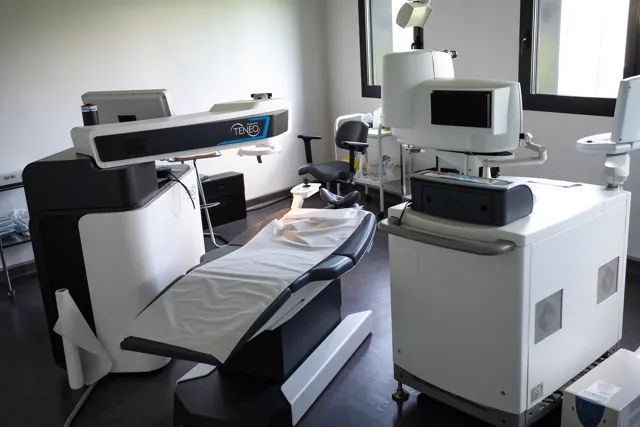
High myopia: what tests are needed before an implant?
Laser surgery has its limits in high myopia. Correcting −10 dioptres would require removing too much corneal tissue. A phakic implant is another option: a lens placed inside the eye, in front of the natural lens, which stays in place. The implant leaves the cornea untouched and can be removed if needed. It fits into a narrow space inside the eye, so very precise measurements are needed before surgery and regular follow-up afterwards. At Annecy Laser Vision, Dr Florian Baudin inserts phakic implants.

Who may be offered a phakic implant instead of laser surgery?
A phakic implant may be considered in several situations.
- High myopia that is too strong for the thickness of the cornea to allow laser treatment.
- A thin cornea or a cornea with a suspicious shape that rules out laser treatment.
- Significant hyperopia, using specialised implants.
- Associated astigmatism, using toric implants.
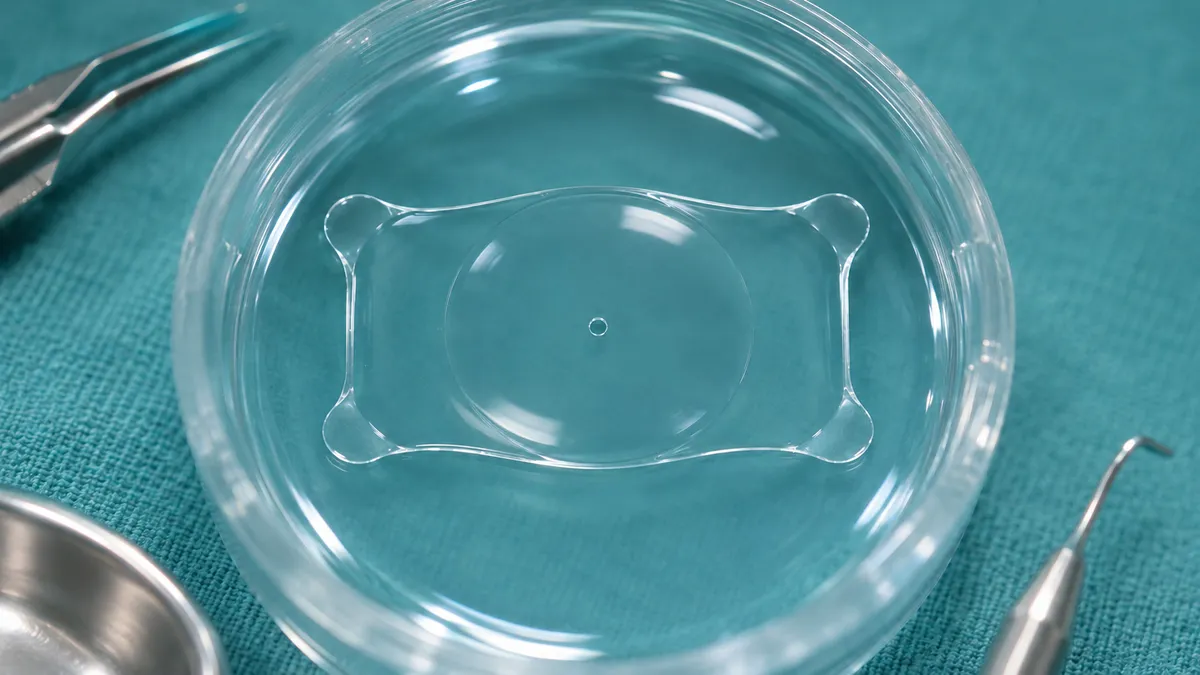
The most commonly used implant, the ICL, is a soft collamer lens placed behind the iris and in front of the natural lens. In the United States, approval for the EVO/EVO+ ICL and TICL models covers patients aged 21 to 60. The correction ranges depend on the model. In Europe, the ranges are wider and include hyperopia and astigmatism. Phakic implants · The phakic ICL implant, on annecy-ophtalmo.fr
Measurements taken at the assessment
| Measurement | Why it matters | Guide |
|---|---|---|
| Anterior chamber depth | The implant must fit between the cornea and the natural lens without touching either | The US ICL labelling requires at least 3.0 mm |
| Endothelial cell density | These cells on the inner surface of the cornea keep it clear and do not regenerate | The younger the patient, the higher the minimum count |
| Eye diameter (white-to-white and sulcus-to-sulcus) | Determines the size of the implant, which needs to fit securely without being too tight | Chosen from several available sizes |
| Iridocorneal angle | A narrow angle increases the risk of raised eye pressure | Measured using imaging and during the examination |
| Refraction under cycloplegia | The implant power is calculated from the exact prescription with the eye’s focusing system relaxed | Must be stable |
| Examination of the back of the eye | The retina is more vulnerable in high myopia | Examination of the peripheral retina and preventive treatment if needed |
At the Centre médical des Aravis, the team uses the ANTERION anterior segment scanner to measure the anterior chamber and angle in cross-section, and the Nidek specular microscope to count the endothelial cells. The centre’s equipment, on annecy-ophtalmo.fr
Why endothelial cells are counted throughout life
The layer of endothelial cells naturally thins with age. If the cell count falls too low, the cornea swells and becomes cloudy. Manufacturers set an age-dependent minimum count before surgery so that enough cells should remain at age 75. In the US ICL labelling, for example, this ranges from 3 875 cells per mm² at ages 21 to 25 to 2 075 cells per mm² after age 45. The average observed loss is about 2 % a year. That is why the count is repeated regularly after surgery, usually once a year.

Measuring the vault after surgery
After surgery, your surgeon measures the gap between the implant and the natural lens, known as the vault. If it is too small, the implant can touch the natural lens and cause a cataract. If it is too large, it can push the iris forwards and interfere with the drainage of fluid from the eye. Newer implants have a tiny central opening that helps fluid circulate and, in most cases, removes the need to make a preventive opening in the iris with a laser.
Risks to know about
Like any surgery inside the eye, a phakic implant carries risks. These are rare but include infection, raised eye pressure, early cataract, faster than expected loss of endothelial cells and halos at night. Regular checks are used to detect problems early. The implant can be removed if necessary, for example during cataract surgery years later.
In summary. A phakic implant corrects high myopia without removing corneal tissue. It requires a detailed assessment of the anterior chamber depth, endothelial cell count, eye diameter, angle and retina. After surgery, the cell count and vault measurement are repeated every year.
Frequently asked questions
Are both eyes operated on the same day?
Yes. For phakic implants, both eyes are operated on the same day. Your surgeon will explain what to expect.
Can you see the implant?
It sits behind the iris and can only be seen during examination under a microscope.
What happens to the implant if I develop cataract?
It is removed during cataract surgery and replaced with a suitable cataract lens implant. When your myopia prescription changes
Check your eligibility or book an appointment to find out whether an implant may be suitable.
Sources
Related reading
All news
News
Contact lenses: what to tell your surgeon at the assessment
If you wear contact lenses, the main thing to do before a refractive surgery assessment is to stop wearing them in good…
13 March 2026

News
Skiing and refractive surgery: what to ask before a trip
In Haute-Savoie, the same question comes up every winter. Can you have eye surgery during the season and keep skiing? Yes. Refractive…
28 November 2025

News
What our patient satisfaction survey found
In October, we asked 66 patients who had undergone refractive surgery to complete a survey. We received 34 responses, a response rate…
29 October 2023
Have a question about your situation?
An assessment tells you what is and isn’t possible and allows you to get a quote.