LASIK
LASIK corrects short-sightedness (myopia), long-sightedness (hyperopia) and astigmatism by reshaping the cornea beneath a very thin flap. It is the most commonly performed laser technique, especially because recovery is quick. Vision is often functional by the next day. The trade-off is that the flap remains a little more vulnerable than the rest of the cornea. Here is what you need to know to make a decision.
Book an appointment online
Doctolib · Refractive surgery, first consultation
Online booking is in French. Reception answers the phone.
What happens during the procedure?
Anaesthetic drops are used throughout. The laser part takes a few minutes per eye.
- The femtosecond laser creates the flap, a thin layer about 100 to 120 microns thick that remains attached at one side. The centre's femtosecond laser is the ELITA.
- The surgeon lifts the flap like turning a page in a book.
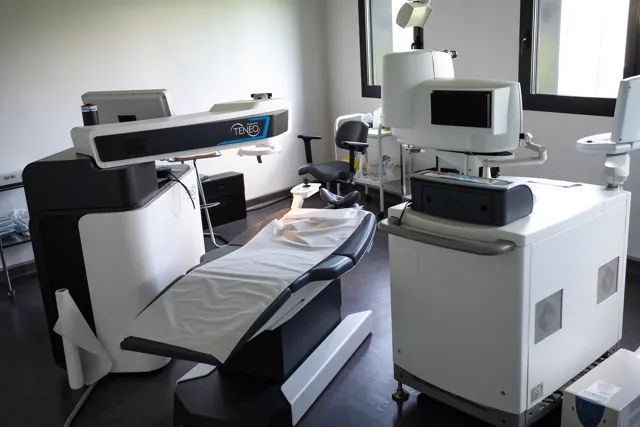
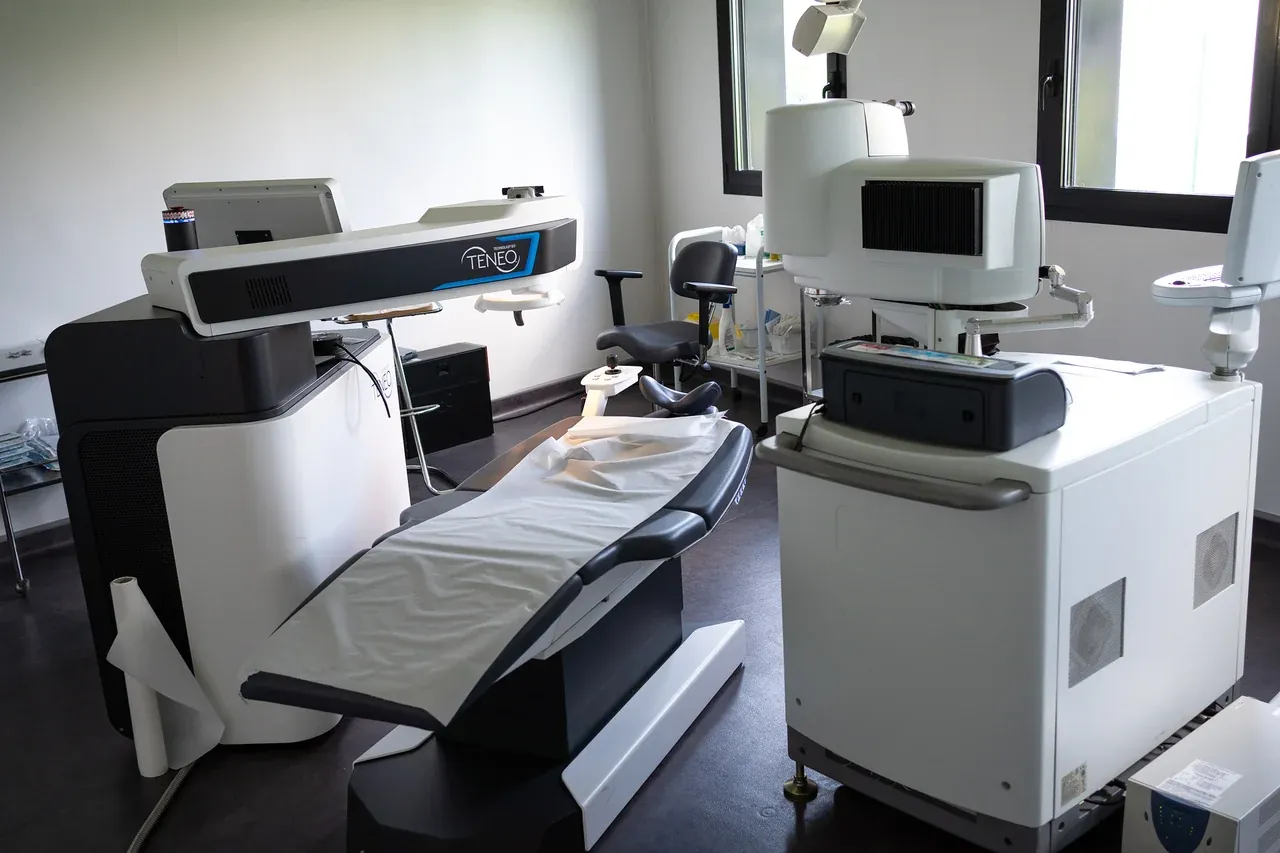
- The excimer laser reshapes the stroma, the tissue that gives the cornea its shape. This is done with the TENEO 2, which tracks small movements of the eye.
- The flap is put back into place and adheres without stitches.
Who is it suitable for?
The first requirement is a stable prescription for at least one year. The assessment then checks what your prescription alone cannot tell us: the cornea's thickness and shape (corneal topography rules out early keratoconus), the condition of your tears and your prescription under cycloplegia (dilating drops). Another technique may be advised if you have thin or irregular corneas, significant dry eye or take part in activities where blows to the face are common. What corneal topography measures
Presbyopia is an important consideration. After age 45, LASIK corrects distance vision, but you will still need glasses for close work. PresbyLASIK is an option in this case, with its own trade-offs. Near vision after age 45
After the procedure
| When | What happens |
|---|---|
| First few hours | Gritty feeling, watery eyes and sensitivity to light. Rest is advised |
| Next day | Vision is often functional. Follow-up check at the centre |
| First few weeks | Vision may fluctuate. Continue using your drops. Dry eyes are possible |
| Sport | Depends on any discomfort and how your eye feels, with your surgeon's approval |
| A few months | Vision and dry eye symptoms stabilise |
You can often return to work quickly, depending on your job and how much time you spend in front of a screen. Sick leave is not issued. This is elective surgery, so schedule it during annual leave or over a weekend. When to return to sport
Risks to be aware of
- Dry eye. Making the flap cuts corneal nerves that control tear production. In FDA studies, about 28 % of patients who didn't have dry eye before surgery reported it at three months. It is usually temporary and is treated with artificial tears.
- Glare and halos at night, more noticeable in the first few months.
- A remaining need for vision correction, which may warrant further treatment by lifting the flap.
- Flap complications, such as a fold or displacement after an impact, even years later. That's why combat sports warrant particular care.
- Infection and secondary distortion of the cornea (ectasia) are rare. The assessment is intended to help prevent them.
LASIK or PRK (PKR)?
| LASIK | PRK (PKR) | |
|---|---|---|
| First few days | Rapid visual recovery, little pain | Discomfort for 2 to 3 days, blurred vision until healing is complete |
| Flap | Yes, protect it from impacts | No |
| Return to work | Often the next day or after a few days | 3 to 5 days |
When visual results are comparable after a few months, the choice depends on how quickly you recover, your cornea and your activities. Three types of corneal surgery · Understanding PRK (PKR)
At the centre in Argonay
LASIK is performed by Dr Florian Baudin, Dr Florian Chaise and Dr Aurélia Gave using the ELITA (femtosecond) and TENEO 2 (excimer) lasers. The cornea and the eye's surface are measured during the assessment before any laser treatment. The ELITA and TENEO 2 lasers · Prepare for your assessment · Book an appointment
Frequently asked questions
Will I see well the next day?
Often, yes, but your vision may fluctuate for a few weeks. A follow-up is scheduled for the next day to check the flap and adjust your treatment.
Is a touch-up possible?
Yes, in most cases, provided the remaining cornea is thick enough. Further treatment can be done by lifting the flap or treating the surface.
Will I still need my glasses?
For distance vision, going without glasses is the aim and often the outcome. A mild prescription may still be useful for some tasks, and you should allow for presbyopia, which develops around age 45.
Can I choose between LASIK and PRK (PKR)?
Yes, once you have had your assessment. The centre will explain why it recommends one or the other.
General information. Only a consultation can determine whether surgery is appropriate and specify the instructions for your care.
Medical sources
- Société Française d'Ophtalmologie, patient information leaflet 09A on corneal refractive surgery, January 2026
- FDA, what happens during LASIK and follow-up care
- NHS, laser eye surgery and lens surgery
Book an appointment online
Doctolib · Refractive surgery, first consultation
Online booking is in French. Reception answers the phone.