PRELEX: refractive lens exchange
From about the age of 45, the crystalline lens, the eye's natural lens, loses its flexibility: this is presbyopia. Over the years it eventually becomes cloudy. PRELEX (PREsbyopic Lens EXchange, or refractive lens exchange) replaces this lens, still clear or only slightly cloudy, with an implant calculated to correct your vision, both near and far. It is the same procedure as cataract surgery, but offered to reduce your dependence on glasses rather than to restore vision damaged by a cataract. At the centre, it is performed by Dr Florian Baudin.
Book an appointment online
Doctolib · Refractive surgery, first consultation
Call the officeOnline booking is in French. Reception answers the phone.
From about the age of 45, the crystalline lens, the eye’s natural lens, loses its flexibility: this is presbyopia. Over the years it eventually becomes cloudy. PRELEX (PREsbyopic Lens EXchange, or refractive lens exchange) replaces this lens, still clear or only slightly cloudy, with an implant calculated to correct your vision, both near and far. It is the same procedure as cataract surgery, but offered to reduce your dependence on glasses rather than to restore vision damaged by a cataract. At the centre, it is performed by Dr Florian Baudin.
Who is it for?
PRELEX is generally aimed at patients aged about 55 to 60 and over, when laser is no longer the right tool:
- presbyopia that means you need reading glasses, sometimes varifocals, all the time;
- high hyperopia (long-sightedness), often revealed or worsened by age, which laser corrects poorly at this age;
- a lens that is already slightly cloudy, but with a cataract not advanced enough to be operated on in its own right;
- usually no eye disease that would limit the result (retina, macula, cornea, glaucoma).
Before this age, the cornea can be treated by laser: see PresbyLASIK. The choice between the two is discussed at the assessment.
What replacing the lens changes
The natural lens is removed once and for all and replaced by an implant that does not age. Two consequences to remember:
- a cataract can no longer develop, since the lens that would have produced it is no longer there;
- the operation is not reversible: you cannot get your own lens back. The implant can be exchanged in particular cases, but that is a surgical procedure in its own right.
Choosing the implant
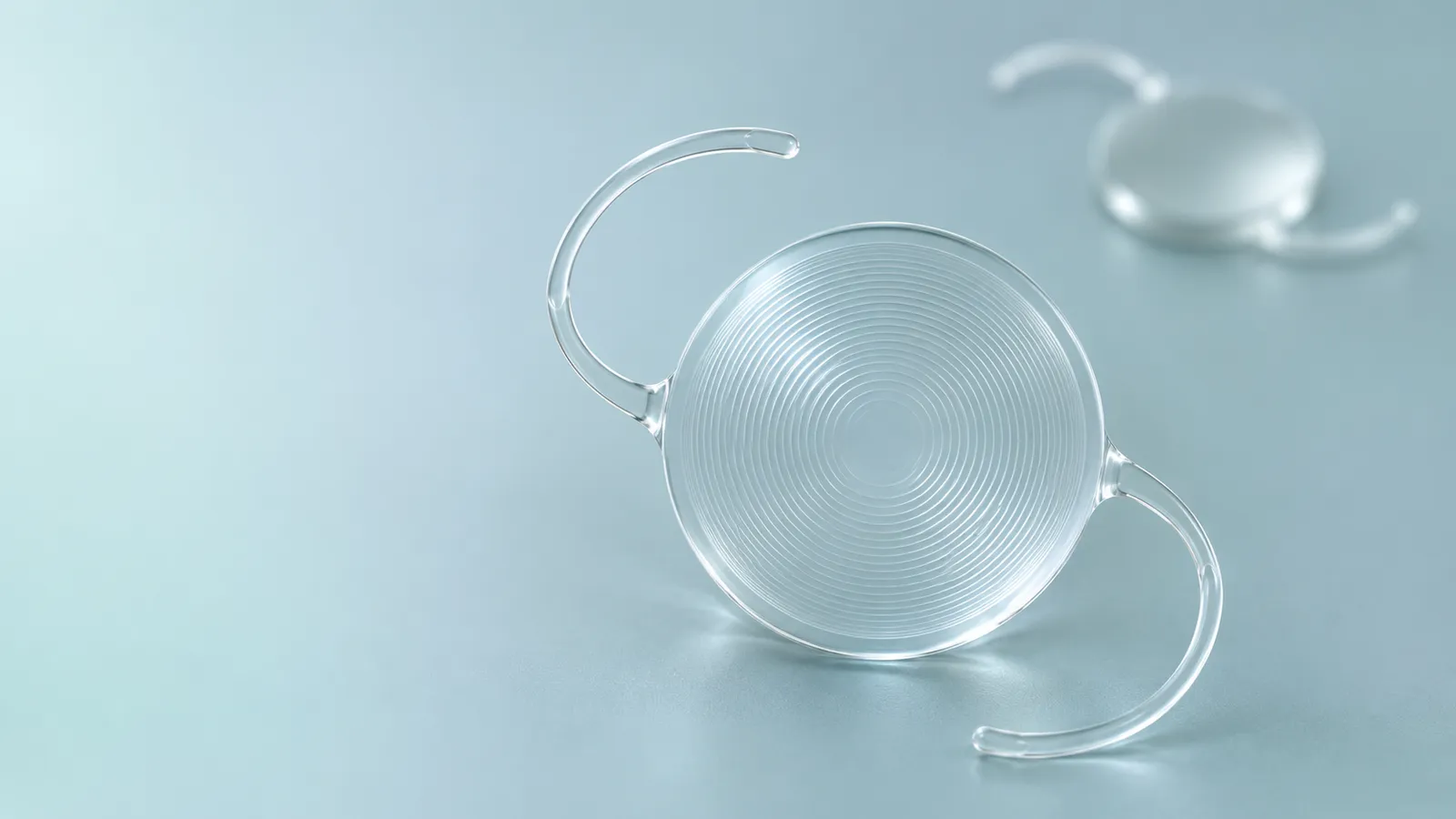
This is the real question, as with cataract surgery. The implant is calculated from measurements of the eye, notably with the IOLMaster 700 biometer.
| Type of implant | What it offers | Limitations |
|---|---|---|
| Monofocal | One clear distance, most often far; glasses for reading | Does not treat presbyopia |
| Toric | Also corrects astigmatism | Requires precise positioning |
| EDOF (extended depth of focus) | Far and intermediate vision (screen, dashboard), few halos | Glasses often still useful for fine reading |
| Multifocal | Far, intermediate and near vision, so that glasses are not needed in most situations | Possible night-time halos, contrast sometimes reduced, adaptation takes a few weeks |
At the assessment, tell us how you spend your days: screens, reading, night driving, gardening, sport. This guides the choice far more than the implant’s technical data sheet. Near vision after 45
PRELEX, PresbyLASIK or glasses: comparing
| PresbyLASIK | PRELEX | Glasses or contact lenses | |
|---|---|---|---|
| What is treated | The cornea, with a laser | The lens, replaced by an implant | Nothing: external correction |
| Usual age | Early presbyopia, around 45 to 55 | Around 55 to 60 and over | Any age |
| Future cataract | Still possible | Can no longer develop | Still possible |
| Reversibility | No | No | Yes |
The assessment before surgery
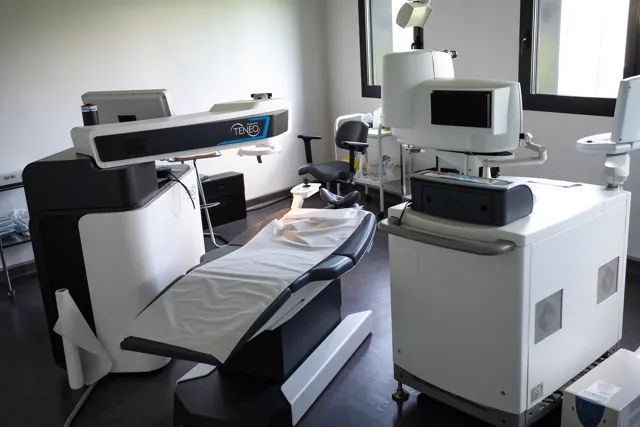
It checks that the eye is healthy and takes the measurements needed to calculate the implant: eye length, corneal curvature, anterior chamber depth, endothelial cells, a full fundus examination and an OCT of the macula. The retina is examined carefully, because it determines the result. If you wear contact lenses, you stop wearing them before the measurements: soft lenses one week, rigid lenses three weeks. The equipment
The procedure
It takes place at the Argonay clinic, as a day case, under local anaesthesia with eye drops, and usually takes about fifteen minutes per eye. The surgeon opens the eye through an incision of a few millimetres, breaks up the lens with ultrasound (phacoemulsification), aspirates it, then slides the implant into the capsular bag that held it. The two eyes are operated on one after the other, on a date agreed with the surgeon.
After the procedure
You put in antibiotic and anti-inflammatory eye drops yourself for a few weeks, according to the prescription. Vision improves within a few days but stabilises more slowly, as the brain adapts to the implant. Strenuous exercise, swimming pools and eye make-up are discouraged for a period set by the surgeon. Check-ups take place after a few days and then after a few weeks. If glasses are still useful, they are prescribed once your vision has stabilised.
Risks and limitations
Serious complications are rare, but they exist and need to be understood before deciding, especially as the eye being operated on is often healthy:
- infection inside the eye (endophthalmitis), the most feared: a red, painful eye or a sudden drop in vision means you must call the centre without waiting;
- retinal detachment, more frequent in highly myopic people and after surgery on the lens, which shows as flashes, floaters or a curtain in the field of vision;
- inflammatory cystoid macular oedema (Irvine-Gass syndrome), common on OCT but benign in the great majority of cases, which clears with anti-inflammatory eye drops;
- secondary clouding of the membrane that supports the implant, months or years later, treated in a few minutes with a painless laser shot;
- halos or glare at night with multifocal implants, which usually fade with time;
- a difference from the intended correction: the implant calculation has a margin of error, and a small correction with glasses or laser is sometimes needed.
No result can be guaranteed: the decision is made with the surgeon, knowing the alternatives.
Alternatives
Glasses or contact lenses for near vision, PresbyLASIK when the cornea and age allow, a phakic implant for some cases of high myopia, or simply waiting and monitoring if the inconvenience remains moderate.
Cost and coverage
The cost depends on the implant chosen and on the situation of each eye: it is given to you as a quote after the assessment. Fees and coverage
Prepare your assessment · Care pathway and follow-up · Appointment
General information. Only the assessment can establish whether the procedure is appropriate and allow us to give you a quote. The procedure takes place at the Argonay clinic, as a day case.
Sources
- American Academy of Ophthalmology, What is refractive lens exchange?
- American Academy of Ophthalmology, presbyopia
- Société française d’ophtalmologie, patient information sheets (in French)
- Annecy Ophtalmo, cataract implants and refractive lens surgery (in French)
Book an appointment online
Doctolib · Refractive surgery, first consultation
Call the officeOnline booking is in French. Reception answers the phone.