What to bring to your assessment
The refractive surgery assessment answers a specific question: can your eyes be corrected surgically, and if so, how? The measurements are taken at the appointment, but part of the answer depends on what you bring: your prescription history, your contact lenses, details of your treatments and your medical history. Bringing a complete record avoids a second appointment and helps you have a more specific discussion.

What to prepare
| What to bring | Why |
|---|---|
| Your current glasses, including reading or driving glasses | Your glasses are measured with a lensmeter and compared with the results of your refraction that day |
| Your previous prescriptions, ideally covering 3 to 5 years | They show whether your prescription is stable, an essential requirement for laser treatment |
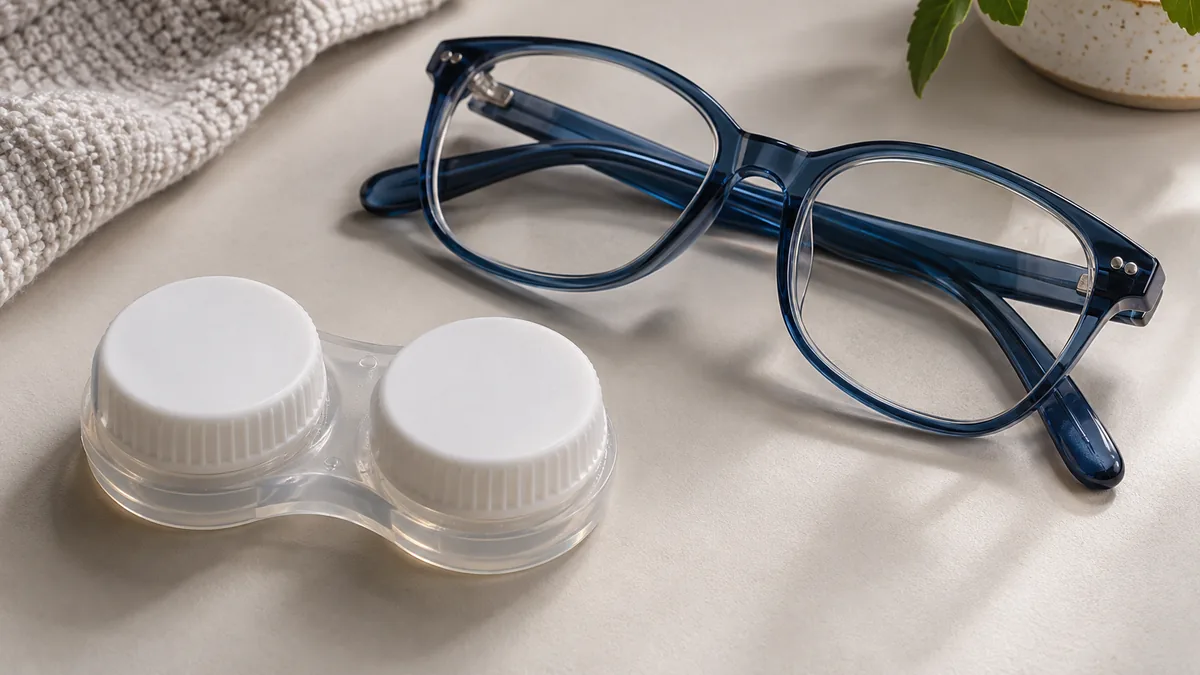
| The case or the model reference of your contact lenses, and the date you last took them out | Contact lenses temporarily change the shape of the cornea and affect the accuracy of the corneal maps |
| A list of your medicines and eye drops | Some treatments affect healing or the eye's surface |
| Any reports from previous eye examinations | A history of keratoconus, uveitis or retinal detachment changes what surgery, if any, is medically indicated |
| Carte Vitale, supplementary health insurance (mutuelle) card and proof of identity | Usual administrative checks |

Medical and family history to mention, even if it seems unrelated
Some aspects of your general health or family history directly affect the choice of technique and may determine whether surgery is possible at all. Make a note of the following before your appointment:
- a family history of keratoconus, because this progressive change in the shape of the cornea has a hereditary component. If you are found to have keratoconus, LASIK is contraindicated;
- treatment with isotretinoin (prescribed for acne), which dries out the eye's surface during and after treatment.
- an autoimmune disease (polyarthritis, lupus or Gougerot-Sjögren syndrome) or diabetes, which can slow healing.
- a history of ocular herpes, which can be reactivated by corneal surgery.
- pregnancy or breastfeeding. Your prescription may fluctuate during this time and the procedure is not performed.
- regularly rubbing your eyes, which is common in people with allergies and weakens the cornea.
When to stop wearing contact lenses
Before your pre-operative measurements at the centre, you need to have stopped wearing soft contact lenses for at least one week and rigid contact lenses for at least three weeks. Even a comfortable contact lens slightly changes the curvature of the cornea. Taking measurements too soon risks calculating the treatment on the basis of a cornea that has not regained its usual shape. If you wear orthokeratology lenses (worn at night to reshape the cornea), mention this when you book because you need to stop wearing them for longer. What to tell us if you wear contact lenses
What happens at the assessment
Leave extra time in your day for the measurements, pupil dilation and your discussion with the surgeon. The most common tests are listed below.
| Test | What it measures |
|---|---|
| Refraction, before and after eye drops | Your exact prescription, without the eye's focusing mechanism masking it |
| Corneal topography and tomography | The curvature and shape of the two surfaces of the cornea, as well as its thickness, to identify a vulnerable cornea |
| Pupillometry | Pupil diameter in low light, which helps anticipate halos and how well you may see at night |
| Examination of the tears and eyelids | The quality of the tear film, which determines comfort after surgery |
| Fundus examination | The retina, especially its outer edges in people with short-sightedness (myopia) |
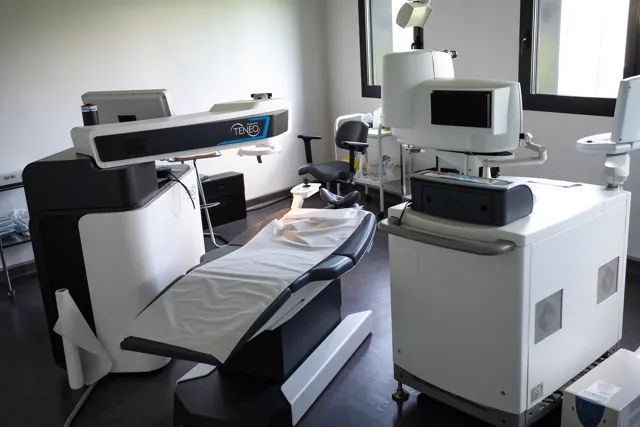
At Centre médical des Aravis in Argonay, the diagnostic equipment includes an ANTERION corneal tomographer, a CA-800 topographer, an IOLMaster 700 biometer, a Nidek specular microscope and an EIDON wide-field retinal camera. Equipment at the centre, on annecy-ophtalmo.fr · What does corneal topography measure?
Why bring someone with you?
Part of the refraction test takes place after drops are put into your eyes to dilate your pupils and temporarily stop your eyes from focusing (cycloplegia). For several hours, your near vision is blurred and light causes glare. Bring someone with you or come by public transport, and bring sunglasses. The centre in Argonay is served by line 9 of the Sibra network, at the Champ Farçon stop. Directions and parking
What you take home
At the end of the assessment, the surgeon will tell you whether one or more techniques could be suitable or explain why it is best to avoid surgery. You will receive information on the proposed technique, an informed consent form and a personalised quote (devis). You can take time to decide. Read the documents at home and make a note of any questions you want to ask later.
Eligibility assessments take place in Argonay, Faverges, Rumilly and Sallanches. Surgery takes place at Annecy Laser Vision in Argonay.
What to remember. Bring your glasses, previous prescriptions, the model reference for your contact lenses and a list of your treatments. Stop wearing soft lenses one week beforehand and rigid lenses three weeks beforehand. Bring someone with you, as dilating drops affect your vision for several hours.
Frequently asked questions
I no longer have my previous prescriptions. Will that prevent me from having an assessment?
No. Your optician often keeps a record of your spectacle lenses and can send it to you. Otherwise, your surgeon may ask for a further examination a few months later to confirm that your prescription is stable.
Can I drive myself home?
Driving isn't recommended after dilating drops. Arrange for someone to come with you or make travel arrangements.
Does having an assessment commit me to surgery?
No. Its purpose is to determine whether surgery is appropriate and give you the information you need to decide. The assessment may also conclude that surgery is unsuitable.
To book your assessment, contact reception or read about what to expect at each step.
Sources
Related reading
All news
News
Long-sightedness and close work: describing your symptoms
Long-sightedness (hyperopia) is often associated with difficulty seeing up close. A young person with hyperopia can often see clearly both far away…
12 November 2026

News
Near vision after 45: what questions should you ask?
Holding the menu further away, stretching out your arm to see your phone or needing bright light to read a medicine leaflet…
3 April 2026

News
Swimming in contact lenses: precautions to know
Between Lake Annecy, the swimming pool and holidays by the sea, contact lens wearers face the same question every summer. Health authorities…
28 May 2026
Have a question about your situation?
An assessment tells you what is and isn’t possible and allows you to get a quote.