

High myopia: phakic ICL as an alternative to laser surgery
Short-sightedness blurs distance vision while preserving near vision. It is common, becoming more prevalent and usually straightforward to correct. High myopia raises particular concerns. Laser treatment has limits and the [...]

Short-sightedness blurs distance vision while preserving near vision. It is common, becoming more prevalent and usually straightforward to correct. High myopia raises particular concerns. Laser treatment has limits and the risk of eye complications is higher. A phakic ICL is one possible option.
Options for correcting short-sightedness
| Option | What it offers | Limitations |
|---|---|---|
| Glasses and contact lenses | Effective correction without surgery | Can be inconvenient in everyday life. Contact lenses require strict hygiene and may cause discomfort such as dryness or irritation. |
| Myopia control in children and adolescents | Special glasses, orthokeratology and eye drops can slow progression | Only for young people whose short-sightedness is progressing |
| Laser surgery (LASIK, PRK (PKR)) | Very effective corneal reshaping | Cornea thick enough, short-sightedness within treatable limits and no significant dry eye |
| Refractive lens exchange (PRELEX) | Replaces the natural lens with an implant | Mainly after age 55 to 60, or for very high myopia with early cataract |
| Phakic implant (ICL) | A lens is added to the eye while the natural lens stays in place | Surgery inside the eye with regular follow-up |
The phakic ICL implant
The ICL (Implantable Collamer Lens) is a miniature, ultra-thin, biocompatible lens made of Collamer, a material well tolerated by the eye. The surgeon inserts it through a small incision, placing it behind the iris and in front of the natural lens, which stays in place. It refocuses light on the retina to restore clear vision.
When it may be considered
- high or very high myopia
- a cornea that is too thin for LASIK or PRK (PKR)
- pre-existing dry eye that laser treatment could worsen
- intolerance to contact lenses
- a preference for reversible correction, since the implant can be removed.
Potential benefits
- correction of a wide range of refractive errors
- preservation of the cornea without removing tissue
- preservation of natural focusing for near vision in patients who have not yet developed presbyopia.
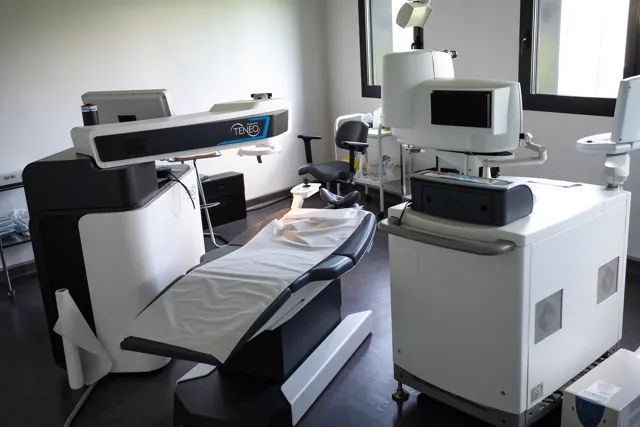
Dr Florian Baudin performs the procedure at Clinique d’Argonay (Ramsay Santé), Annecy Laser Vision’s surgical partner. Measurements before a phakic implant
Watch the procedure
Dr Baudin explains the technique and the steps of the operation performed at Clinique d’Argonay.
In summary. An ICL can correct short-sightedness without removing corneal tissue when laser treatment is unsuitable. A full pre-operative assessment determines your eligibility and the most suitable approach.
Useful links
- Book an appointment with Dr Baudin on Doctolib
- Annecy Laser Vision’s YouTube channel
- News from Clinique d’Argonay on LinkedIn
- Société française d’ophtalmologie, patient leaflet on phakic implants
This information is general and cannot replace a consultation. A full pre-operative assessment is needed to determine the most suitable approach for your vision.
Related reading
All news
News
Our surgeons at the ESCRS 2025 world congress
Dr Béchet, Dr Chaise and Dr Baudin are attending the 43rd congress of the European Society of Cataract and Refractive Surgeons (ESCRS)…
7 September 2025
News
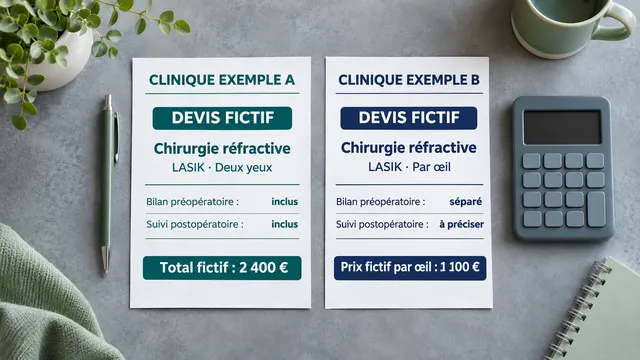
How to compare two quotes for refractive surgery
Refractive surgery is a significant expense and the French statutory health insurance scheme (Assurance maladie) rarely reimburses it. It makes sense to…
26 October 2026

News
Alcon 2024 presbyopia consensus: Dr Baudin and Dr Béchet
Dr Florian Baudin and Dr Lorane Béchet, ophthalmologists at the eye practice at centre médical des Aravis and at Annecy Laser Vision,…
29 September 2024
Have a question about your situation?
An assessment tells you what is and isn’t possible and allows you to get a quote.
